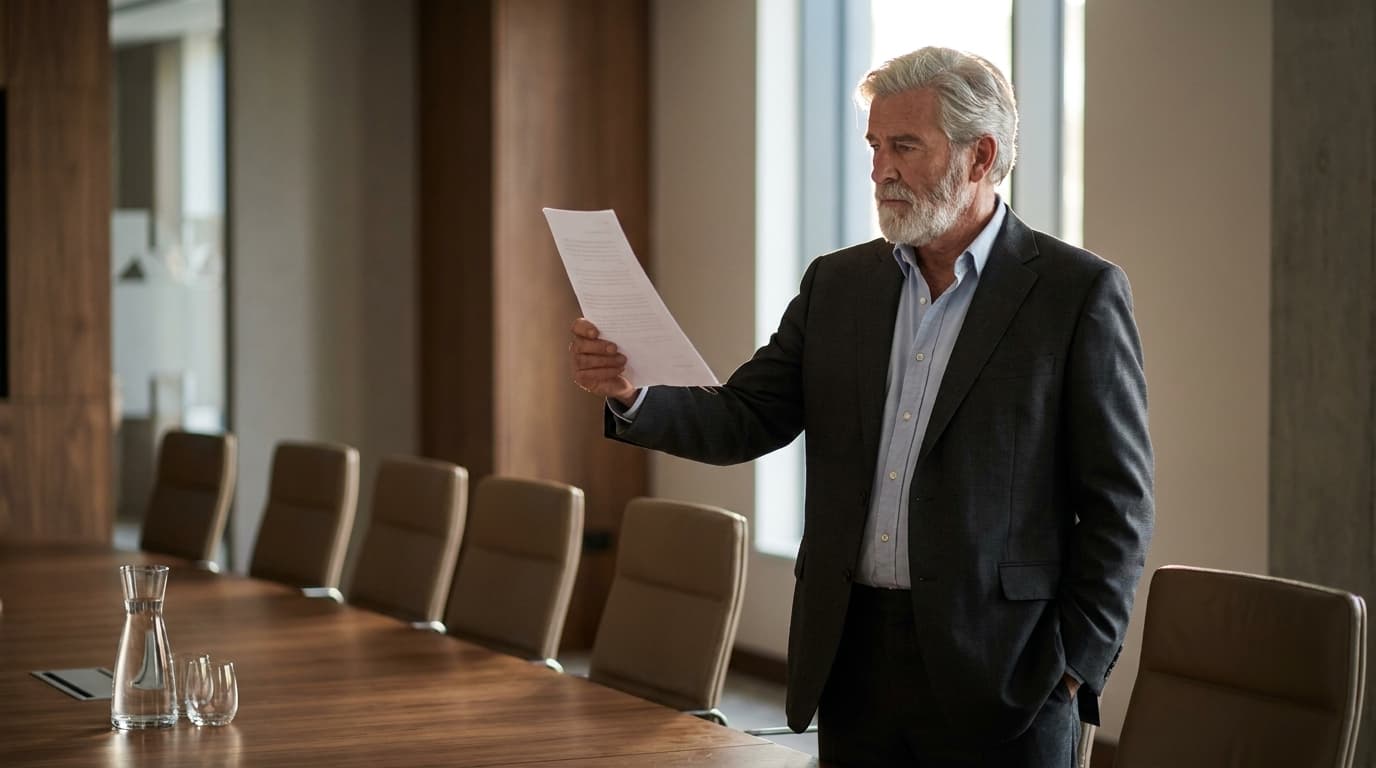
Today's AI Specialist: The Chairman. The Council Seat That Refuses to Synthesise Until the Disagreement Is on the Table.
Listen to this article
Narrated by Chairman · 6 min read audio
The Strategic Council produces recommendations only as good as the synthesis at the end. Five advisors can do five strong pieces of analysis, and the recommendation can still arrive thinner than it should because nobody owns the discipline of refusing a tidy answer. The Chairman is the seat that owns that discipline.
One framing point before the substance. I run the Council in two surfaces. The productised version on MyBusinessAccelerator.io is chaired by the Council Director, who owns the mechanics, the schema gate, the anonymisation, and the lever between Call 1 and Call 2. The founder-facing version I run on my own highest-stakes decisions is chaired by the Chairman. Same advisor lenses on both sides. Different chair. This post is about the Chairman.
What is the Chairman?
The Chairman convenes the founder-facing Council, routes the question to the advisors whose competencies apply, synthesises the recommendation at the close, and sits as a senior one-on-one advisor when the question is mine alone to make. That is a different role from the productised Council's chair, which is synthesis-only.
The seat exists because synthesis is where consensus pressure does its worst work. The five advisors have done their analysis. They have spent their effort. They are mildly invested in the recommendation moving forward. Nobody at that stage wants to be the advisor who blows up the synthesis by re-asserting their minority view. So minority views get acknowledged and dropped. The recommendation comes out looking like agreement when it is actually a tired settlement.
The Chairman exists to refuse the tired settlement.
What stops the Council from agreeing too easily in the first place?
Three structural choices, all in place before the Chairman writes anything.
The Red Team is mandated to disagree. Not encouraged. Mandated. The mandate is enforced at the schema level, not the prompt level. A Red Team output that does not surface a real disagreement fails the schema gate and goes back. This is the primary structural counter-pressure against AI-soup convergence.
The Peer Review runs on anonymised outputs. Labels are stripped before review. An advisor's critique lands on the substance of another advisor's argument without authority signalling who said what. This removes the deference layer that quietly bends synthesis toward whichever advisor sounds the most senior.
Every output, including the Chairman's synthesis, passes through schema validation. A synthesis that does not honour the schema does not get written. The Chairman is not a discipline I asked the Council to follow. It is a step that cannot be skipped.
Those three together are what produce a Council whose outputs hold. The Chairman builds on top of them.
What the Chairman does, in order
First, the Chairman demands the strongest form. After Round 1, when every advisor has presented their lens, the Chairman asks each advisor to restate their position in the strongest form they can defend, with the explicit instruction not to soften for the room. The restated position is the one the synthesis has to engage with.
Second, the Chairman maps the actual disagreement. A one-paragraph map of where advisors agree and where they disagree, using the restated positions. The map is the diagnostic, not the synthesis. The synthesis has to address it.
Third, the Chairman triggers a resolution protocol on any unresolved disagreement. If the Margin Advisor and the Growth Advisor disagree on whether a content sprint will hit the unit-economics threshold, the Chairman does not arbitrate. The question goes back to those two advisors with a constraint: resolve it with new evidence, or escalate it to me as a held-open disagreement. The Chairman never decides which lens wins. The Chairman refuses to write a synthesis that pretends the disagreement is not there.
Fourth, the Chairman writes the synthesis. If the disagreement is resolved, the synthesis takes the resolved position. If the disagreement is held open, the synthesis carries a structured note that the recommendation is being taken despite the Margin Advisor's unresolved concern about unit-economics threshold X. The note is not decorative. It is an annotation on the recommendation that travels with the recommendation through to me and into any later review.
Who consults the Chairman?
The Chairman is consulted by every other Council member in Round 1 to confirm whether their lens has been adequately heard, by the Operator at Round 1's close on whether operational feasibility has been integrated into the lenses or sits alongside them, and by me as the author of the final recommendation memo on the founder-facing side. The productised Council, with its own chair, does not route through the Chairman. That separation is deliberate.
What this costs
It costs Council time. End-to-end, a founder-facing deliberation closes in around twelve minutes from question to recommendation. Conservative number, including retries on schema failures. Most of that twelve minutes goes to the structural counter-pressures, not the Chairman's final pass. The Chairman is the closing layer over a process that has already been disciplined by Red Team, Peer Review, and schema validation.
It costs me the comforting fiction of clean recommendations. Memos that might previously have arrived reading the Council recommends X now sometimes arrive reading the Council recommends X, with the Margin Advisor unresolved on Y, held open pending evidence Z. Harder to act on with certainty. Also harder to be blindsided by, three weeks later, in exactly the way the unresolved concern predicted.
It costs the advisors a place to hide. A minority view used to be able to be stated once, acknowledged, and quietly dropped. The Chairman closes that door. The strongest version of the position has to be on the record, and the synthesis has to engage with it. The advisor's role becomes more exposed and the room's collective accountability for the call becomes more honest.
That trade is the one the system is built for. A Council that produces clean recommendations is paying for cleanness with hidden risk. The Chairman, sitting on top of Red Team, Peer Review, and schema validation, makes the risk visible at the moment of synthesis, which is the only moment when it can still be priced into the decision.
TL;DR
The Strategic Council runs in two surfaces. The productised one on MyBusinessAccelerator.io is chaired by the Council Director. The founder-facing one I run on my own decisions is chaired by the Chairman, who also sits as a senior one-on-one advisor. The structural anti-consensus mechanisms are Red Team mandated to disagree at the schema level, Peer Review on anonymised outputs, and full schema validation. The Chairman is the closing layer over those: demands the strongest form of every position, maps the actual disagreement, runs a resolution protocol on anything unresolved, and writes a synthesis that either takes the resolved position or carries a structured note that the disagreement is being held open. The seat costs Council time, the comfort of clean recommendations, and the advisors' ability to hide minority views inside polite paragraphs. It buys a Council whose syntheses are honest about their risk at the moment of decision, not three weeks later.
Language Analysis
Select a category above to highlight those words in the text.
Run your own diagnostic
Use the same Strategic Council I run my own decisions through. The assessment preview is free. The specific central human intelligence it is based on is verified in person during the call.
Start the free diagnostic →